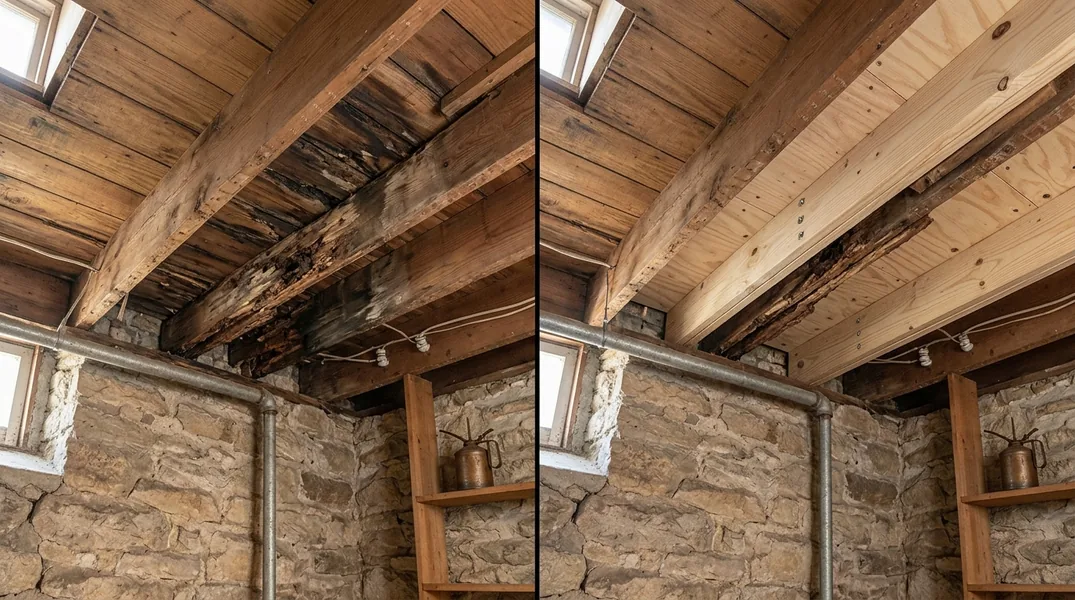
Why Is My Floor Sagging? The Madison Home Owner's Guide
If you own an older home in Madison, you've probably noticed it: a slight dip in the hardwood floor near the kitchen, or a noticeable sag running along the perimeter of the basement. That gentle slope isn't just a cosmetic quirk of a century-old house. It's a warning sign that something structural is failing beneath your feet.
Sagging floors happen for several reasons, but in Madison's historic neighborhoods, the culprits are almost always the same. Fieldstone basements, which are common in homes built before 1920, settle unevenly over time. Wooden sill plates that sit directly on those fieldstone foundations absorb moisture and rot. Floor joists, which should be solid and level, weaken and bow under the weight of the house. When these structural elements fail, the floor above them doesn't stay flat.
The good news: sagging floors can be repaired. The bad news: ignoring the problem will only make it worse and more expensive to fix. Understanding what's happening beneath your floor is the first step toward getting your home back on solid ground.
Rotted Sills and Fieldstone Foundations: A Perfect Storm
Madison's oldest homes rest on fieldstone foundations, a building method that was practical and affordable in the 1800s but has significant drawbacks by today's standards. Fieldstone is porous, absorbs moisture from the soil, and provides an uneven bearing surface for the wooden sill plate that sits on top of it. The sill plate is the critical connection between the house frame and the foundation. It carries the entire weight of the structure and distributes it across the stone below.
When moisture from the fieldstone wicks into the wooden sill, the wood begins to rot. Wood Rot and Dry Rot Repair becomes necessary because the wood loses its structural integrity. Soft, crumbly rot eats away at the sill from the inside out, and homeowners often don't notice until the damage is severe. By the time you can see visible rot or feel the floor move, the sill may have lost 50 percent or more of its load-bearing capacity. The house settles, the floor sags, and the joists above begin to bend under stress.
The fieldstone itself compounds the problem. Unlike a modern concrete foundation, fieldstone doesn't provide a level, stable surface. Differential settlement (where different parts of the foundation settle at different rates) is common, creating uneven support for the sill and joists. This is why many old Madison homes have floors that dip more dramatically in some areas than others.
Floor Joists Under Stress: When Beams Begin to Bow
Floor joists are the horizontal wooden beams that run beneath your floorboards. They're designed to be straight and strong, supporting both the weight of the floor itself and everything on it: furniture, people, appliances, and more. In a well-maintained home, joists can last for centuries. But when the sill rots, when moisture penetrates the basement, or when the foundation settles unevenly, the joists bear the consequences.
A rotted or inadequate sill doesn't provide proper support at the ends of the joists. Without that support, the joists begin to sag in the middle. As they sag, they lose their ability to span the distance they were designed to cover. The problem compounds itself: a sagging joist creates a low spot in the floor, and that low spot collects water and moisture, which accelerates rot in the joist itself. Floor Joist and Subfloor Repair often requires not just replacing the sill but also reinforcing or replacing the joists that have been compromised.
Some homeowners try to ignore a slightly sagging floor, thinking it's just part of owning an old house. But a sagging joist is a failing joist. It's working harder than it should, and it will continue to deteriorate. Eventually, the sag becomes severe enough that doors won't close properly, cracks appear in plaster walls above, and the structural integrity of the entire house is compromised. This is why addressing floor joist problems early is so important.
Sistering Floor Joists: The Real Fix for Sagging Floors
When a floor joist is damaged but not completely rotten, the most effective repair method is called sistering. This involves installing a new or reinforced beam alongside the damaged joist and bolting or fastening them together. The new beam shares the load with the weakened joist, restoring the structural support and eliminating the sag.
Sistering is preferred over full joist replacement because it's less invasive and often more cost-effective. The new beam is cut to match the length and dimension of the existing joist and is installed along its side. Steel plates and bolts or specialized fasteners are used to bind the two beams together, creating a composite beam that's stronger than either one alone. When done correctly, sistering can raise a sagging floor back to level or nearly level.
The process does require careful work. The sistered beam must be properly sized to handle the load, and it must be installed with precision to ensure it actually contacts and supports the existing joist. Poor sistering work can look fine but provide little actual benefit. This is why it's important to hire experienced carpenters who understand structural repair, not just general carpentry. Madison Carpentry has completed hundreds of sistering projects in older homes throughout the area, and we know how to assess whether sistering alone will solve your problem or whether additional work, such as sill replacement or Beam Replacement and Load-Bearing Wall Removal, is needed.
Sagging Floor Repair Cost in Madison: What to Budget
The cost of repairing a sagging floor depends on the extent of the damage, the length of the joists involved, and whether the sill needs to be replaced. A simple sistering project on a few joists might cost between $2,000 and $5,000. A more comprehensive repair involving sill replacement, multiple joists, and foundation work can easily run $10,000 to $25,000 or more. The only way to know what your home needs is to have a professional inspection.
Madison Carpentry offers a free, no-obligation assessment of your sagging floor. During this inspection, we'll examine the foundation, sill, joists, and surrounding structure to determine exactly what's causing the sag and what repairs are necessary. We'll provide a detailed estimate that breaks down labor, materials, and any additional work that might be recommended. For a detailed look at our pricing and service options, visit our website or call us at (608) 471-7359.
Keep in mind that addressing floor sag early is almost always cheaper than waiting. A small repair now prevents a major structural failure later. If you've noticed your floors starting to sag, don't delay. The longer the problem persists, the more damage spreads to surrounding joists, the sill, and even the foundation itself.
What to Do If You Suspect Floor Sag: Next Steps
If you're noticing a dip or sag in your floor, the first step is to document it. Take photos and note where the sag is most noticeable. Walk around your basement or crawlspace and look for visible signs of rot, moisture, or structural damage. Check whether doors are sticking or whether you notice cracks in walls or ceilings above the sagging area. These observations will help a professional carpenter diagnose the problem.
Next, contact Madison Carpentry for a free estimate. We'll schedule a time to inspect your home, identify the root cause of the sag, and recommend the most effective and economical repair strategy. Whether your home needs sistering, sill replacement, or a combination of repairs, we'll explain your options in clear, straightforward terms. You won't be pressured into unnecessary work, and you'll have a realistic understanding of what your repair will cost and how long it will take.
Sagging floors are a serious issue, but they're also a solvable one. Thousands of older homes in Madison and surrounding areas have been successfully repaired and restored to structural soundness. Your home can be too. Call Madison Carpentry at (608) 471-7359 or visit our website to schedule your inspection today.
Looking for a professional carpentry contractor in Madison? Madison Carpentry responds fast for all your carpentry needs.
Get a Free QuoteOur services: Wood Rot & Dry Rot Repair · Termite Damage Repair · Floor Joist & Subfloor Repair