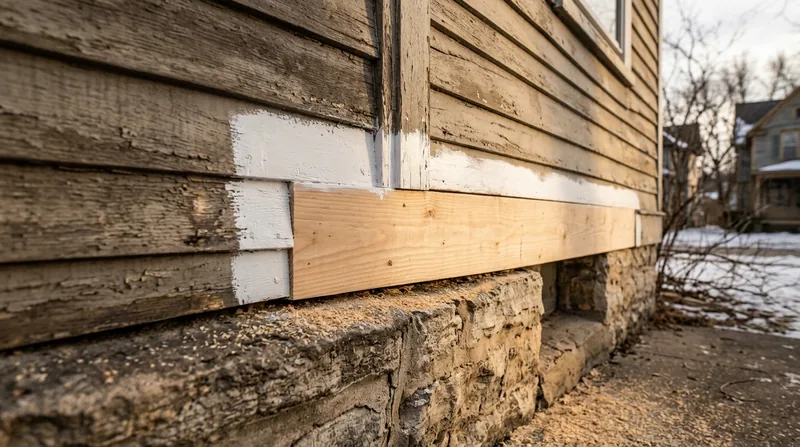




Madison's isthmus sits between two lakes, and that geography brings relentless moisture. Ice dams back meltwater into fascia and soffits; spring snowmelt soaks porch posts and deck ledgers; humid summers keep wood from ever fully drying. The result is wood rot and dry rot repair work that keeps us busy year-round on the Queen Anne houses of Mansion Hill, the deep-eaved Craftsman bungalows of Vilas and Dudgeon-Monroe, and the older worker cottages packed tight on the west side. Sill plates and rim joists sit right at the damp line of fieldstone basements. Original trim and wood storm windows take the worst of the weather. We cut out decayed framing, siding and trim, treat the surrounding wood, and rebuild with rot-resistant lumber. This is a permanent repair, not a cosmetic patch.
Why Wood Rot & Dry Rot Repair Matters in Madison's Older Homes
Water and freeze-thaw cycles are the real enemies of wood in Madison. Unlike climates where heat and dry air dominate, our lake-country winters and spring snowmelt create conditions where moisture stays trapped in wood for months. Carpenter ants follow that dampness into soft sills and window frames. Decay spreads quietly through joist ends and rim joists before a homeowner notices soft spots or springy flooring. Early repair stops the spread and preserves the structural wood underneath. Waiting costs exponentially more.
- Identify soft spots, discoloration, or sponginess in sill plates, rim joists, porch posts and exterior trim.
- Test suspect wood with a screwdriver or awl, which will sink easily into decayed fibers.
- Check basement walls and crawl spaces for standing water, seepage or evidence of past flooding.
- Look at fascia, soffit and gutter conditions, which control water runoff and ice dam formation.
- Have a pest inspection done if you suspect carpenter ant or termite activity alongside rot.
Catching rot early is the difference between a targeted repair and a structural overhaul.
Key info: Madison's older neighborhoods like Tenney-Lapham and Schenk-Atwood have homes with sill plates and rim joists sitting directly on fieldstone basements that weep every spring. We regularly find rot at these junctions because water migrates up capillary action and sits against wood for weeks at a time. This is not a rare or exotic problem, it is the most common structural wood issue we address.
For official guidance on moisture and wood decay in residential structures, the USDA Forest Products Laboratory publishes research on wood durability and moisture control that applies directly to Madison's climate.
How We Repair Wood Rot in Madison: Our Process
We start with a thorough site inspection to find all affected wood, not just the visible soft spots. Decay often extends deeper into framing than surface appearance suggests. We then remove all rotted material, treat the surrounding wood to arrest any remaining decay, and rebuild with pressure-treated or naturally rot-resistant lumber matched to the original species and dimensions. The repair is permanent and structural, designed to last as long as the original wood frame.
- Inspect the damage zone and probe adjacent framing to locate the full extent of decay.
- Remove rotted wood using hand tools and chisels, working carefully to preserve sound framing.
- Treat exposed wood surfaces with a wood preservative to stop active decay.
- Cut and fit new lumber, sistering joists or replacing rim joist sections as required.
- Seal the repair with flashing, caulk or paint to prevent new moisture entry.
- Address the source of the moisture, whether that means gutter repair, grading, or basement sealing.
This methodical approach means the repair stays sound and doesn't fail again in five years.
Local example: A 1920s bungalow in Vilas had rot at the porch post base and throughout the rim joist on the north side. The ice dam that winter had backed water into the wall cavity. We removed 8 linear feet of compromised rim joist, sistered new pressure-treated lumber alongside the intact portions, replaced the porch posts with cedar, and installed new flashing and trim to shed water. The repair cost $2,400 and took three days. The alternative, waiting until the decay reached the floor joists, would have required full subfloor replacement and cost $8,000 or more.
See our related work in Floor Joist & Subfloor Repair for cases where rot has reached the structural framing deeper into the home.
Wood Rot Repair Methods: When to Repair vs. Replace
| Approach | Description | Best for |
|---|---|---|
| Localized removal and rebuild | Cut out the decayed section only, sister new lumber or splice in a new piece, treat surrounding wood. | Rot limited to one area, sound wood on both sides, no structural compromise. |
| Full member replacement | Remove the entire joist, post, rim joist section or trim board and install new lumber of identical dimensions. | Decay spans more than 30 percent of the member or affects a load-bearing element like a floor joist. |
| Sistering and reinforcement | Install a new joist or beam alongside a weakened member, bolted or nailed securely, to share the load. | Rot or damage that reduces load capacity but the original member is still partially sound. |
| Moisture control and prevention | Repair gutters, improve grading, seal basement walls, install flashing or improve ventilation to stop water entry. | Early-stage decay or recurring moisture problems; prevents future damage and extends wood life. |
The right choice depends on the extent of decay, the structural role of the member, and whether the surrounding wood is salvageable. We assess each situation on site and recommend repair over replacement when the wood justifies it.
Wood Rot & Dry Rot Repair Cost in Madison: What to Expect
A straightforward wood rot repair in Madison typically starts at $650 and scales with the scope. A small section of rotted trim or a single porch post might fall into that range. A larger repair, such as 10 to 15 linear feet of compromised rim joist or multiple rotted floor joists, generally runs $1,800 to $3,500. The cost depends on how much wood must be removed, whether the repair is structural or cosmetic, access to the damage, and whether the moisture source requires additional work like gutter or grading repair.
Factors that increase cost include structural involvement (floor joists and rim joists cost more than exterior trim), difficult access (crawl spaces and tight corners take longer), and the need to address the underlying moisture problem. A porch post replacement with new footings and flashing might be $800 to $1,200. Extensive rim joist repair with new sistered joists can reach $4,000 to $6,000. We provide a free estimate on site so you understand what you're paying for and why.
Getting two or three estimates from different carpenters is smart practice. You'll see variation in approach, timeline and price, and that comparison helps you make an informed decision. See our full pricing overview for additional context on structural carpentry costs in the Madison area.
What to Look for When Hiring a Wood Rot Repair Carpenter Near Me in Madison
Choose a carpenter who explains what he sees and why the repair matters, not one who dramatizes the damage or pushes replacement when repair is honest. You want someone who will probe the wood carefully, identify the moisture source, and rebuild with the right material for the job. Ask for references from recent wood rot or structural repair work, not just a general list. A good contractor will walk you through the estimate and answer questions about why he chose a particular repair method or material.
Verify that the contractor is fully insured and carries liability and workers' compensation coverage. Ask to see the certificate. For structural work, such as sistering joists or replacing rim joists, check whether a permit is required by contacting the Madison building department directly. Permit rules vary, and your contractor should be able to guide you through the process. If you live in an HOA or historic district like Mansion Hill or Tenney-Lapham, confirm that exterior work complies with any design guidelines. Call us for a free estimate at (608) 471-7359 and we'll walk you through the process and answer any questions about the scope and cost before you commit.
Wood Rot & Dry Rot Repair in Madison: Pricing Guide
| Service | Price | Details |
|---|---|---|
| Small rot repair (trim, single post, or localized framing) | Starting at $650 | Includes removal of decayed wood, treatment, and rebuild with new material, plus labor up to 8 hours on-site |
| Medium repair (10-15 linear feet of rim joist or multiple joists) | $1,800 to $3,500 | Removal, sistering or full replacement of structural members, treatment, and flashing to stop future moisture entry |
| Large or complex structural repair (extensive joist replacement, load-bearing assessment, moisture remediation) | On estimate | Scope requires on-site inspection to assess structural role, access, and whether permits or engineer consultation is needed |
| Moisture source repair (gutters, grading, basement sealing related to rot) | Varies by scope | Addressing the cause of moisture entry is often bundled with wood repair to prevent recurrence and extend structural life |
| Travel and estimate | Free estimate, no mileage charge | Included in Madison and surrounding service areas; response within 24 hours at (608) 471-7359, no obligation |
Indicative pricing, the exact cost depends on square footage, finish, and site access. Free personalized estimate within 24h at (608) 471-7359.


