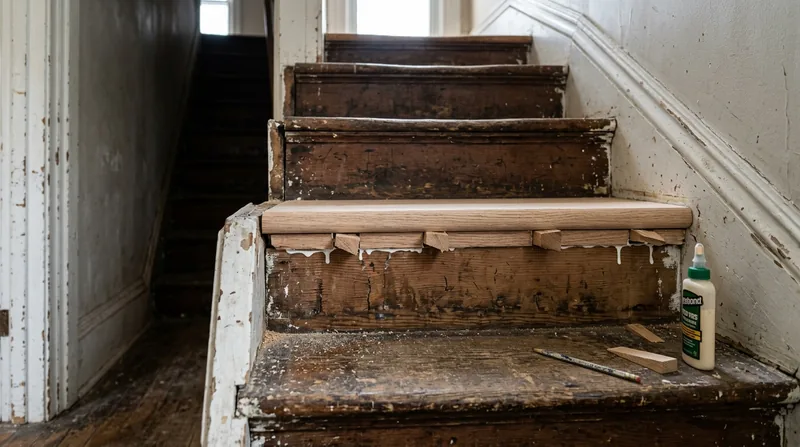




Madison's steep Victorian staircases, basement stairs climbing from century-old fieldstone foundations, and narrow worker-cottage landings take a beating from foot traffic, freeze-thaw cycles, and the heavy snow loads that settle on exterior porches every winter. Stair and railing repair in Madison is not cosmetic work: a squeaky tread masks loose fasteners, a wobbly baluster signals rot in the stringer or newel post, and a sagging porch stair can fail without warning when ice and moisture weaken the structural wood underneath. We repair and rebuild staircases throughout Madison, Middleton, Fitchburg, Sun Prairie and the surrounding isthmus communities, restoring original railings on Queen Anne and Craftsman homes, replacing worn treads and stringers, and installing code-compliant handrails where safety demands them.
Why Stair and Railing Repair Matters in Madison's Older Homes
Madison's signature housing stock, from 1880s Queen Annes packed onto Mansion Hill to 1940s Cape Cods in Westmorland, relies on wood staircases as primary circulation. Exterior stairs on front porches and basement entries sit directly in the moisture zone where porch posts rot, where spring meltwater soaks the stringer, and where freeze-thaw cycles crack wood and loosen fasteners. Interior stairs in tall isthmus houses climb two or three stories, and a loose tread or compromised railing becomes a liability. Most of these stairs are original or near-original, meaning fasteners have loosened over a century, wood has compressed and shifted, and rot has begun in the lower stringers or newel posts where water collects.
- We tighten loose treads, risers and balusters by re-fastening or replacing hardware and wedges.
- We replace rotted stringers, treads and risers in wood that no longer holds fasteners or bears weight safely.
- We restore original period railings, handrails and newel posts on Queen Anne, Craftsman and Prairie School homes.
- We install modern code-compliant handrails and safety railings where local building code requires them.
- We repair or replace attic ladders, basement stairs and exterior porch stairs that have failed or begun to move.
Addressing stair and railing problems early prevents accelerated rot, keeps the structure safe for daily use, and preserves the character of Madison's historic neighborhoods.
Key info: Madison's spring melt and freeze-thaw cycles work against exterior porch stairs constantly. A stringer that shows soft spots or a tread that moves underfoot should be inspected immediately. Delaying repair allows water to penetrate deeper into the wood structure, accelerating rot and increasing replacement cost. Call (608) 471-7359 for a free assessment.
For more on the structural damage that moisture causes, see our wood rot and dry rot repair page.
How We Repair and Rebuild Stairs: Our Process in Madison
Every stair and railing job starts with a careful inspection of the wood, fasteners, and structural integrity. We identify which components can be repaired (tightened, re-fastened, or reinforced) and which must be replaced because the wood no longer holds fasteners or bears load safely. For interior stairs, we often work around active household use, scheduling work to minimize disruption. For exterior porch stairs, we assess water intrusion, rot depth, and whether the entire stringer needs replacement or just the tread and riser.
- We inspect the entire staircase, checking treads, risers, stringers, balusters, handrails and fasteners for movement, rot, or wear.
- We identify which components are salvageable and which require replacement based on wood condition and safety.
- We remove damaged treads, risers, or stringers carefully, preserving original balusters and railings where possible.
- We replace stringers, treads and risers in new wood that matches the original species and profile when appearance matters.
- We reinstall or restore handrails and balusters, ensuring all fasteners are tight and the structure meets current safety codes.
- We test the completed staircase for movement, squeaks and safety before finishing and cleanup.
This methodical approach means your staircase is safe, stable and visually consistent with your home's period and character.
Example: A Mansion Hill Queen Anne had a front porch stair with a rotted stringers and loose balusters. Rather than replace the entire stair, we sistered new Douglas fir stringers alongside the existing ones, replaced the treads and risers in matching wood, and re-secured the original turned balusters. The restored stair now matches the 1910 newel post and maintains the home's architectural integrity while being fully safe and stable.
Related work: we also handle deck and porch repair for the structural framing and ledger boards that support exterior stairs.
Stair and Railing Repair Methods
Different stair problems call for different solutions. A squeaky interior stair tread may need only re-fastening, while an exterior porch stair with a rotted stringer requires structural replacement. The table below shows the most common approaches we use in Madison homes.
| Approach | Description | Best for |
|---|---|---|
| Re-fastening and tightening | We tighten loose fasteners, replace missing screws or bolts, and re-wedge treads and risers in their stringers. | Squeaky treads, loose balusters, and wobbly railings caused by loose hardware rather than rot. |
| Sistering stringers | We fasten new stringers alongside existing ones, reinforcing or replacing structural support without removing the entire staircase. | Stringers with minor rot or compression, where the staircase is otherwise sound and removal would be disruptive. |
| Tread and riser replacement | We remove worn or rotted treads and risers and install new wood in matching species and profile, re-using original stringers and balusters. | Exterior porch stairs and interior stairs where the walking surface is damaged but the stringer structure is sound. |
| Complete staircase replacement | We remove the entire staircase and build a new one, replicating the original profile and period details when appropriate. | Extensive rot, structural failure, or when a staircase is too compromised to repair safely or economically. |
| Handrail and railing restoration | We restore original turned balusters, handrails and newel posts, reinforcing them where needed and ensuring code compliance. | Period homes where original railings are part of the architectural character and safety upgrades are needed. |
Stair and Railing Repair Cost in Madison: What to Expect
Stair and railing repair costs in Madison start at $600 for basic work like re-fastening loose treads or tightening balusters, and scale upward based on the scope of damage, the number of stairs, wood species and whether original details must be matched. An exterior porch stair with a rotted stringer typically runs $1,200 to $2,500 because the stringer must be replaced, the tread and riser renewed, and all fasteners secured. A complete interior staircase replacement, especially in a tall Victorian or Craftsman home, can exceed $4,000 because of the labor involved in careful removal, custom milling of treads and risers to match original profiles, and the precision required to maintain alignment and safety over multiple flights.
Several factors move cost up or down. Access and space matter: a basement stair in a tight crawlspace takes longer than a wide front porch stair. Wood species affects price: matching original Douglas fir or redwood costs more than using standard pine. Rot extent is critical: a stringer with soft spots only in the lower third can often be sistered, but extensive rot throughout requires full replacement. Original details add cost: restoring turned balusters, period handrails and newel posts takes more time than installing modern code-compliant railings. Permits for structural work or railing alterations may apply, depending on local building code and the scope of work.
We recommend getting 2 to 3 estimates from local carpenters so you understand the scope and can compare approaches. A low bid may mean the contractor plans to patch rather than repair properly, while a high bid may reflect unnecessary replacement. Our estimate is free and includes an honest assessment of what can be repaired and what must be replaced. See our full pricing overview for additional detail on common repair scenarios.
Budget example: A Verona homeowner had an exterior porch stair with a soft stringer and loose treads. Re-fastening and sistering a new stringer cost $1,400. A Fitchburg Victorian with three flights of squeaky interior stairs needed tread re-fastening and new balusters, totaling $1,800. A complete basement stair replacement in a Sun Prairie home, including a new handrail and code-compliant railing, was $3,200. Your actual cost depends on your specific situation. Call (608) 471-7359 for a free, no-obligation estimate.
Stair and Railing Repair Near Me: What Madison Homeowners Should Know When Hiring
Choosing a carpenter for stair and railing work means finding someone who understands both the structural demands of stairs and the aesthetic character of your home. Madison's historic neighborhoods, from Dudgeon-Monroe to Tenney-Lapham, are full of homes where the staircase is a signature architectural feature, and a repair done wrong can damage that character permanently. When you call a contractor, ask how they approach repair versus replacement, whether they have experience matching original wood species and profiles, and how they handle permits if structural work is involved.
Start by verifying that your contractor is fully insured and has liability coverage for the work. Ask for references from recent stair and railing jobs in Madison or nearby towns, and contact those homeowners to confirm the work was completed on time and to their satisfaction. If your staircase is in a historic district or if your home is on a local historic register, check with your local building department or historic preservation office about any restrictions on alterations. Many HOAs in newer Madison subdivisions also have rules about exterior railings and stair finishes, so verify those requirements before work begins. If structural changes are involved, such as removing a wall under the stairs or altering load-bearing support, a permit is likely required. Your contractor should advise you to contact your local building department to confirm what permits apply and what inspections are needed.
Ask for a detailed written estimate that breaks down labor, materials, and timeline. A reputable local carpenter will also explain which components are being repaired and which are being replaced, and why. Don't choose based on price alone: the cheapest bid often means shortcuts in fastening, material quality or finishing. Call us for a free estimate, and we will walk you through your options honestly and give you a realistic timeline and cost range before we start.


