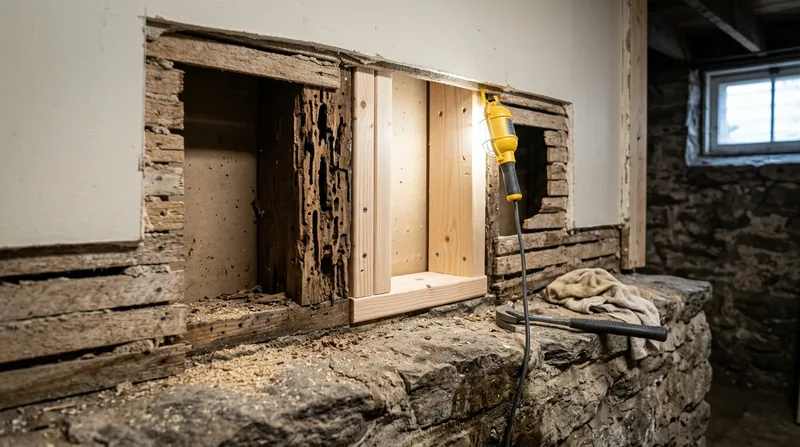




Madison's older neighborhoods, from the Queen Anne and Craftsman homes packed onto the isthmus to the post-war Capes and ranches spreading through Fitchburg and Verona, sit on damp basements and sill plates that invite carpenter ants deep into the wood. Subterranean termites are uncommon this far north, but once your pest control company confirms the infestation and treatment is complete, the damaged wood remains. Termite damage repair in Madison means replacing the hollowed studs, sill plates, rim joists, and subfloor sections that ants have eaten, restoring full structural integrity so your home stands solid again. We work from your pest inspection report, remove the compromised wood, and install sound framing in its place. This is not pest control; this is carpentry. The freeze-thaw cycles, spring snowmelt soaking porch posts and deck ledgers, and humid lake-country summers create the perfect conditions for moisture damage that invites these pests. Once they're gone, we make sure the structure they damaged is sound.
Why Termite Damage Repair Matters in Madison's Damp, Freeze-Thaw Climate
Madison sits between two lakes on an isthmus where moisture is constant. Winter ice dams back water into fascia and rim joists; spring snowmelt soaks foundation perimeters and porch posts; summer humidity keeps wood fiber saturated. Carpenter ants follow that moisture into soft sill plates and window frames, hollowing them out from the inside. Unlike termites in warmer climates that consume wood systematically, carpenter ants tunnel and nest, leaving galleries of sawdust and weakened framing. By the time you see signs, significant wood is already compromised. Structural integrity suffers. Floors sag. Walls shift. The longer damaged wood sits after treatment, the greater the risk of secondary rot and further settlement.
- Carpenter ants hollow out sill plates and rim joists, the critical connection between foundation and frame, causing floors to settle and doors to stick.
- Damaged studs in exterior walls lose load-carrying capacity and allow water to penetrate deeper into the framing cavity.
- Subfloor sections weakened by ant damage create soft spots, uneven floors, and safety hazards underfoot.
- Untreated ant galleries trap moisture and create conditions for wood rot to accelerate, compounding the damage.
Addressing termite damage promptly after pest treatment keeps your home structurally sound and prevents cascading failures down the road.
Key info: Madison's damp basement line is where sill plates and rim joists sit at their most vulnerable. Spring and summer are peak seasons for discovering ant damage because moisture is highest and wood is softest. A homeowner in Tenney-Lapham noticed sagging floors in her 1910 cottage; a pest inspection revealed carpenter ants in the rim joist. We replaced a 12-foot section of rim joist and sistered the floor joists above it, restoring level floors and full support.
For permit and regulatory guidance specific to Madison, homeowners should contact the City of Madison Planning and Development Department to understand structural repair requirements and whether your specific job requires a permit.
How We Repair Termite Damage in Madison: Step-by-Step
Every termite damage repair starts with your pest inspection report. We use that document to identify exactly which wood members are compromised, then assess whether repair or replacement is the right call. If the damage is localized, we remove the hollowed section, install new pressure-treated or solid wood in its place, and tie it back into the sound wood around it. If the damage is extensive, we replace the entire member. All work restores the original load path and structural integrity. We work from the ground up: sill plates first, then rim joists, then floor joists and subfloor, then studs and headers if needed. Each step is tied to the last so the frame sits true and level.
- We obtain your pest inspection report and walk the damage with you to confirm scope and location.
- We remove the damaged wood section by section, exposing the sound wood beyond the damage line.
- We install new members of matching dimension and species, securing them with structural fasteners and nailing patterns that meet code.
- We sister damaged joists where repair is possible, bolting new wood alongside the existing member to restore load capacity.
- We address any secondary moisture issues, such as condensation or standing water, that may have contributed to the original infestation.
Every repair is documented and can be included in your insurance claim file if needed.
Real example: A homeowner in Verona had carpenter ants in her 1950s ranch's basement rim joist. The pest company treated the colony. We exposed the rim joist, found ant galleries running 8 feet along its length, removed the compromised section, installed a new pressure-treated 2x10, and bolted it to the foundation sill and the rim joist on either side. The floor above, which had begun to sag, returned to level. Total time: two days. Cost: $2,400 plus materials.
For more information on related structural repairs, see our guide to floor joist and subfloor repair in Madison.
Termite Damage Repair Methods: Repair vs. Replacement
| Approach | Description | Best for |
|---|---|---|
| Localized section removal and replacement | Remove the damaged 3 to 8 foot section of sill plate, rim joist or stud; install new pressure-treated lumber matching original dimension; bolt or nail into sound wood on either side. | Damage confined to one joist or one wall section; sound wood on either end of the damage. |
| Sistering (reinforcement alongside existing member) | Install a new joist or stud bolted alongside a damaged but still partially functional member, sharing the load and restoring capacity without full removal. | Damage is moderate; removing the old member would be more disruptive than reinforcing it; the existing wood still has structural value. |
| Full member replacement | Remove the entire damaged joist, stud, sill plate or rim joist and install new lumber of matching grade and dimension, secured with modern fasteners and nailing patterns. | Damage spans most or all of the member; the wood is too compromised to carry load safely; repair would be more costly than replacement. |
| Subfloor panel replacement | Remove ant-damaged subfloor sections, install new plywood or OSB panels, screw and glue them to the joists below, and restore flooring on top. | Soft or spongy subfloor; the joists below are sound but the subfloor itself is hollowed; restoring a level, solid floor platform. |
Termite Damage Repair Cost in Madison: What to Expect
Termite damage repair costs in Madison range from $1,200 for a small, localized section repair to $5,000 or more for extensive damage across multiple joists or a full rim joist replacement. The primary factors that affect price are the length and depth of the damage, the accessibility of the damaged wood, whether the damage is in a rim joist or sill plate (harder to access, more labor) or in a floor joist or stud (easier), and whether the repair requires sistering or full replacement. A short section of rim joist damaged by ants might cost $1,800 to $2,500 to remove and replace. A full rim joist running 20 feet or more, or damage spanning multiple structural members, will run higher. Subfloor damage alone is typically $1,500 to $3,000 depending on area and whether joists below need repair too.
The best way to know the real cost is to get a free on-site estimate. Call us at (608) 471-7359 and describe what the pest inspection found; we will visit, assess the damage, measure it, and give you a firm price before any work begins. We recommend getting 2 to 3 estimates so you can compare scope, method, and price. For a detailed pricing overview and typical ranges for common scenarios, see our full pricing guide.
What to Look for When Hiring a Termite Damage Repair Contractor Near Madison
Finding the right carpenter to repair termite damage is about more than price. You want someone who understands Madison's building stock, the connection between moisture and wood failure, and how to tie a repair into existing framing so it lasts. Ask whether the contractor has experience with the specific members you need repaired, whether they pull permits when required, and whether they can explain the repair method clearly. A good contractor will walk you through the damage, explain why repair or replacement makes sense, and stand behind the work with a warranty. Ask for references from past jobs in your neighborhood or in similar houses. Check that they are fully insured and can provide proof of coverage. Get the estimate in writing, including materials, labor, timeline, and cleanup. Avoid contractors who pressure you to decide on the spot or who promise to eliminate the pest infestation themselves, that is a separate regulated trade.
- Verify that the contractor is fully insured with liability and workers compensation coverage, and ask for a certificate of insurance.
- Request references from at least three recent jobs, ideally in Madison, Middleton, Fitchburg or other nearby communities.
- Confirm that the contractor understands when permits are required for structural repair and is willing to pull them if needed.
- Ask whether the contractor has worked on homes of the same era and style as yours, such as 1920s Craftsman bungalows, 1950s ranches or newer suburban homes.
- Get a detailed written estimate that specifies which members are being repaired or replaced, the method (sistering, section replacement, full replacement), materials, labor, and timeline.
For a free estimate and to discuss your specific job, contact us today.
Key info: Madison Carpentry works on termite and ant damage across Madison and surrounding areas including Middleton, Fitchburg, Sun Prairie, Verona, Monona, Waunakee and beyond. We are fully insured. We work from your pest inspection report and do not offer pest treatment ourselves. We repair and replace the wood. If you are unsure whether your damage requires a permit, we will advise you to check with the City of Madison Planning and Development Department, and we handle all permitting if one is needed.
Termite Damage Repair in Madison: Pricing Guide
| Service | Price | Details |
|---|---|---|
| Localized section repair (rim joist or sill plate) | Starting at $1,200 | Short damaged section removed and replaced, sound wood on both ends, includes labor and pressure-treated lumber |
| Full rim joist or sill plate replacement | Starting at $2,400 | Extended damage across 12 to 20 feet of foundation perimeter, new member bolted to foundation and existing frame |
| Floor joist sistering or subfloor replacement | Starting at $1,500 | New joist bolted alongside damaged member or subfloor panels removed and replaced, cost depends on number of joists and square footage |
| Multi-member or extensive structural repair | On estimate | Damage spanning multiple joists, studs or both rim and sill, requires on-site assessment to scope labor and materials accurately |
| Travel within service area | Included | No separate mileage or call-out fee for Madison, Middleton, Fitchburg, Sun Prairie, Verona, Monona, Waunakee and surrounding communities |
| Free estimate | Free | On-site inspection, damage assessment, written quote with no obligation, response within 24 hours at (608) 471-7359 |
Indicative pricing, the exact cost depends on square footage, finish, and site access. Free personalized estimate within 24h at (608) 471-7359.


